Printable Letter Formation Cards
Create A–Z handwriting cards with starting dots, direction arrows, stroke numbers, and writing guidelines. Print and use at home or in the classroom.
Customize and preview letter formation cards
Quick starts
Start from a complete classroom-ready setup, then adjust letters and guidance.
Formation card settings
Choose letters and teaching cues before refining appearance and paper setup.
Letter formation cards printable preview
Output summary
- Cards
- 26
- Pages
- 7
- Paper
- Letter · Portrait
- Content
- Uppercase · Model + trace
Print and download actions
Create formation cards in 3 steps

Choose letter content
Select letters, case mode, and a model or tracing layout.
Adjust formation cues
Set starting points, arrows, stroke numbers, and writing lines.
Preview and output
Inspect the real pages, then print or download the vector PDF.
Move from observation to repeated writing

Study the form
Look at the complete uppercase, lowercase, or paired letter.

Find each start
Name the starting point for each stroke before moving.
Follow direction
Trace the arrows and say the movement aloud.

Use stroke order
Complete the strokes in the numbered sequence.

Move to repetition
Trace once, then continue on a handwriting worksheet.
Choose card content and print setup
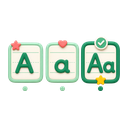
Choose letter case
Use uppercase for foundational movements, lowercase for everyday literacy, or paired cards for comparison.

Layer guidance
Add starting points, direction arrows, stroke numbers, and writing guides only when useful.

Choose the right card size
Use 1-up or 2-up for demonstrations, 4-up for regular practice, and 9-up only for simple reference cards.
Output at actual size
Match A4 or US Letter, choose colour, low-ink, or black and white, then print at 100%.
Continue with tracing practice
Continue with letter tracing practice
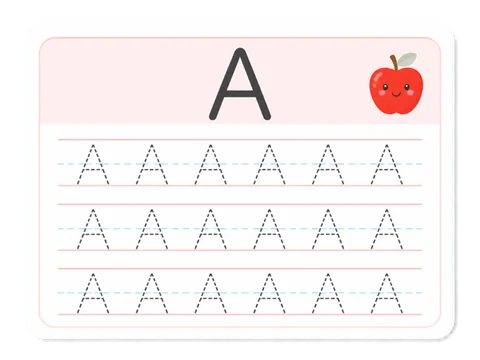
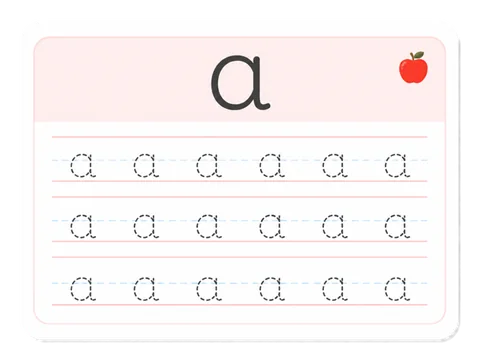
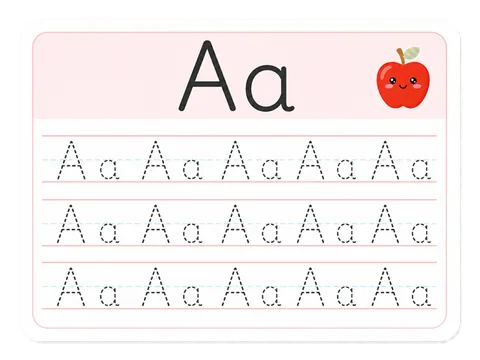
Practice the letters you've just studied with a ready-made tracing worksheet.
Designed for real classroom and home use

Clear, consistent letter forms
The modelled and tracing versions of each letter use the same reviewed shapes.
Flexible letter selection
Use the full alphabet, one letter, a continuous range, or a custom set.

What you see is what you print
The live preview matches the printed page exactly.
Useful for these teaching moments


Frequently asked questions
What are letter formation cards?
How are formation cards different from tracing worksheets?
Can I choose only the letters being learned?
Can I print uppercase and lowercase together?
What do the dots, arrows, and numbers mean?
Why are some card sizes unavailable?
Should I choose A4 or US Letter?
Can I print in black and white?
Does Pracendi use a specific handwriting style?
Can I use the cards at home or in a classroom?
Related learning materials
Continue along the same learning path with letter tracing, online movement practice, and number flashcards.
- Printable creatorNumber FlashcardsCreate free printable number flashcards from 0 to 20 with numerals, quantities, number words, ten frames, A4 or US Letter layouts, and live preview.Open tool
- Companion practiceLetter Tracing Worksheet GeneratorPractice uppercase and lowercase letter formation with printable tracing sheets.Open tool
- Companion practiceUppercase Letter Tracing PracticeTrace uppercase A–Z online, review visual feedback, and open a printable worksheet for the current letter.Open tool
Next learning step
Move from movement modeling to repeated writing
Formation cards make starting points, direction, and order visible; tracing worksheets provide room to repeat the movement.